
InsightsThought leadership
Who Owns Your Energy Transition?
27 October 2026 · 12 min read
Listen
A conversation on this perspective
Listen as a conversation — James and Sarah on why looking into the energy transition becomes a management problem, and what orchestration is for. (about 12 and a half minutes)
The management team agrees: we should reduce energy costs and make progress towards net zero.
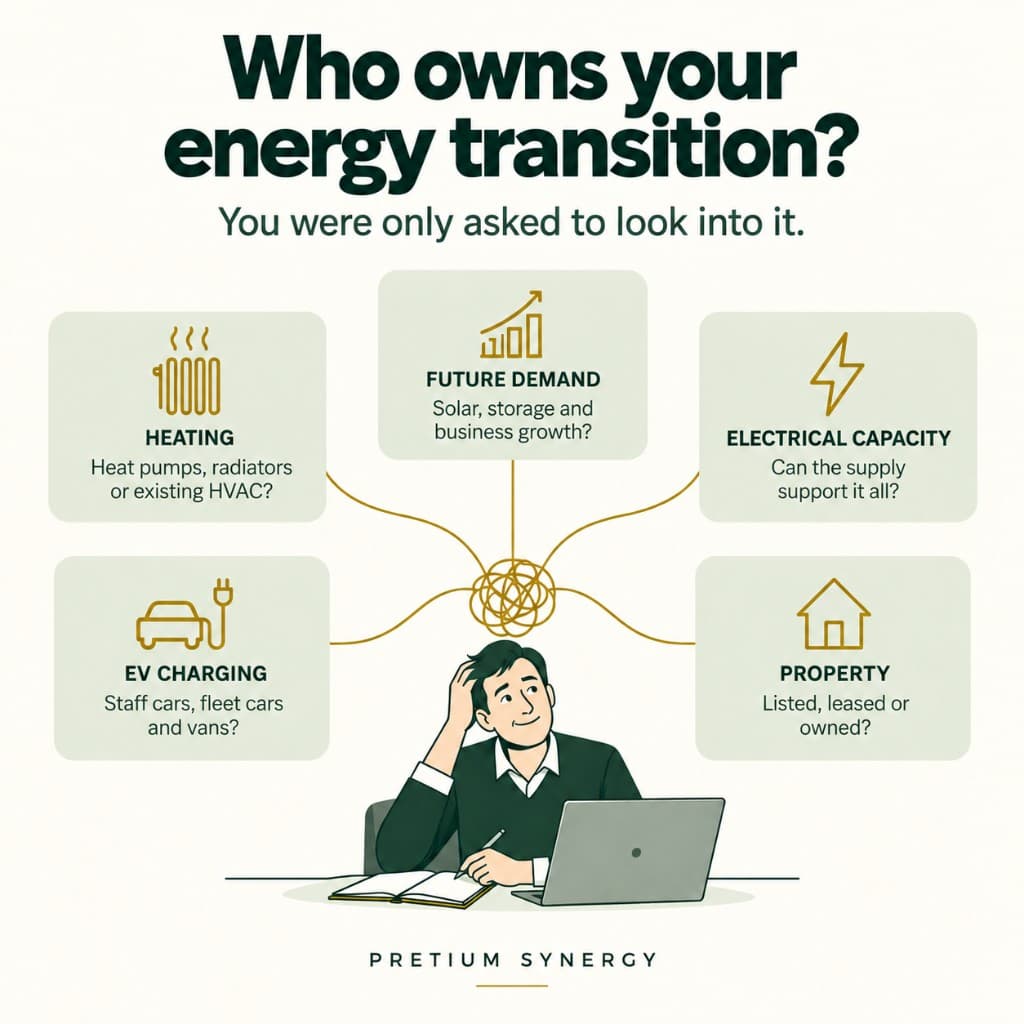
Replacing the gas boilers with heat pumps seems a sensible place to start. That could reduce emissions — but it will increase electricity demand. Can the building’s electrical supply support it?
And what happens to the existing radiators? Can we keep them, or does the heating system need changes too?
Hang on. Parts of the building already have air conditioning that can provide heating. Should we make better use of that before deciding how much replacement heating we need?
Meanwhile, colleagues have been asking for workplace EV charging. How many chargepoints would be useful? What would they cost? Who pays for the electricity? Can charging be managed around the building’s other demands?
Then the fleet manager joins the conversation.
The company cars and vans are due for replacement. Some could become electric. Will they use the same chargers as staff? The vans need to be ready for early departures — can they all charge overnight? Do we now need a larger electrical supply?
Someone suggests solar.
There’s plenty of roof space. But how much generation would we use during the day? Would batteries help with overnight charging? What happens at weekends? Is the roof due for refurbishment?
Property has a few questions.
We own this building, but lease the other two. What needs landlord approval? How much should we invest with five years left on a lease? Could the landlord contribute?
And part of the estate is listed. Which improvements are appropriate there, and what permissions would they need?
Then the managing director reminds everyone that the business is growing.
More people. More equipment. Possibly another shift.
Are we designing for today’s electricity demand — or what we’ll need in five years? Would the proposed upgrade leave room for growth, or would we be paying to change it again?
Finance would like the investment case.
Operations would like assurance that none of this interrupts the business.
The sustainability lead needs credible carbon reductions.
And you would quite like to know when this became your full-time job.
Every question is reasonable
Every department has a legitimate priority. Each supplier can help with part of the answer.
Someone still has to bring the answers together.
The scenario illustrates a management challenge: several connected investments, competing priorities and limited capacity to coordinate the whole transition. A routine installation can remain a routine installation. The need for orchestration grows with the dependencies and the organisation’s capacity to manage them.
Business commitment remains substantial. BSI’s 2026 survey of more than 1,000 UK senior business leaders found that 82% remained committed to net zero. [1] But commitment needs time, funding and a route into operation.
The British Business Bank’s 2025 analysis of 1,783 SMEs found that high costs were a moderate or significant barrier to progress for 66%; lack of finance or grants for 57%; and lack of time for 52%. These barriers overlap. A business can face all three at once. [2]
The value sits between the decisions
A well-integrated transition combines appropriate measures in a workable sequence.
Better controls, lighting, operating schedules, draught reduction or suitable insulation may reduce demand before major equipment is sized. Understanding existing HVAC may change the heating requirement. Coordinating staff and fleet charging may change the electrical upgrade needed.
Roof condition can influence the timing of solar. Lease terms can influence ownership, funding and the investment horizon. Business growth can justify provision for future capacity while still requiring discipline over what is installed today.
These relationships belong in the investment case. Assessing them together can reduce unnecessary expenditure, avoid rework and protect future choices.
Resilience and income need a shared operating strategy
As heating, transport and operations increasingly depend on electricity, management needs a clear view of supply capacity, critical loads and continuity arrangements.
Existing generators and ageing electrical infrastructure need a place in the transition plan, including testing, maintenance and eventual replacement. Solar and batteries can contribute to resilience where backup operation is deliberately designed into the system.
Energy assets may also create value through exports, tariff optimisation and flexibility services. NESO’s Demand Flexibility Service provides participation routes through suppliers and other providers. [3] Access and operating arrangements need to be established before projected income enters the business case.
A battery intended to reduce bills or earn income may also need a backup reserve. Its capacity cannot be allocated independently to every purpose. Priorities must be designed and costed together, allowing for losses, fees, maintenance and asset wear.
Management needs one whole-life financial picture: capital, funding, operating costs, income, support and future replacement.
Who owns the connections?
Some organisations have an experienced internal team or delivery partner to manage this work. Others distribute it across finance, facilities, operations and suppliers, without allocating sufficient capacity to connect their contributions.
Advisers bring specialist judgement. Designers develop technical solutions. Installers deliver agreed works. An orchestrator brings those contributions together around the organisation’s objectives and coordinates the agreed transition through into operation.
At Pretium Synergy, we describe the role through four responsibilities:
- Frame: establish objectives, existing assets, constraints and the investment case.
- Connect: bring design interfaces, funding routes, permissions and specialist partners together.
- Deliver: coordinate procurement, sequencing, quality checks, commissioning and handover.
- Follow through: compare measured performance with agreed assumptions and coordinate investigation and corrective action where needed.
Find a workable route
Orchestration includes helping clients find practical, proportionate ways through constraints.
A limited budget might call for phased investment around equipment replacement. Electrical constraints might require demand reduction, load management or a coordinated supply upgrade. A portfolio may need different solutions for different buildings within one shared framework.
The aim is an achievable sequence, with dependencies visible and the longer-term objective kept in view.
Choose the support and accountability you need
Pretium’s services can support different starting points:
- Advisory: options, investment case, funding routes and consents strategy.
- Programme management and quality assurance: coordination of the agreed programme, including procurement, specialist input, contractor interfaces, inspections, commissioning, handover and performance reporting.
- Turnkey delivery: one delivery contract covering the agreed design and works, including those delivered through subcontractors.
Customers retain control of objectives, investment and approvals. Pretium manages within the agreed authority. Professional and workmanship duties remain with the relevant specialists; in turnkey delivery, Pretium also carries its contractual responsibility for the design and works.
Scope, fees, delivery responsibilities and continuing support should be clear before commitment. Orchestration must earn its place through the management burden it removes, the bottlenecks it addresses and the value it helps the whole investment deliver. Its cost belongs in the financial case alongside maintenance and service charges.
Where Pretium Synergy fits
Pretium Synergy acts as orchestrator for organisations that need a managed energy transition. We start with your objectives, buildings, operations, growth plans and investment capacity, then bring applicable improvements, specialists, funding routes and delivery arrangements into one coherent programme.
That may include demand reduction, heating and cooling, hot water, solar, battery storage, EV charging and electrical infrastructure. The combination and sequence follow your needs.
You were asked to look into the energy transition. You shouldn’t have to become its entire delivery team.
Sources
- BSI, UK Firms Shift from Climate Ambition to Commercial Necessity on Net Zero, 14 April 2026. Survey conducted in February 2026. The figure measures stated commitment.
- British Business Bank, SMEs and Net Zero 2025, pages 42–44. Analysis of the SME subset of the UK Net Zero Business Census; percentages concern moderate or significant barriers.
- NESO, Demand Flexibility Service.