
InsightsThought leadership
Installing EV Chargers Is Easy. Building a Charging Estate Is Different.
15 September 2026 · 6 min read
Listen
A conversation on this perspective
Listen as a short conversation — James and Sarah on when a few chargers become an EV charging estate. (about 5 minutes)
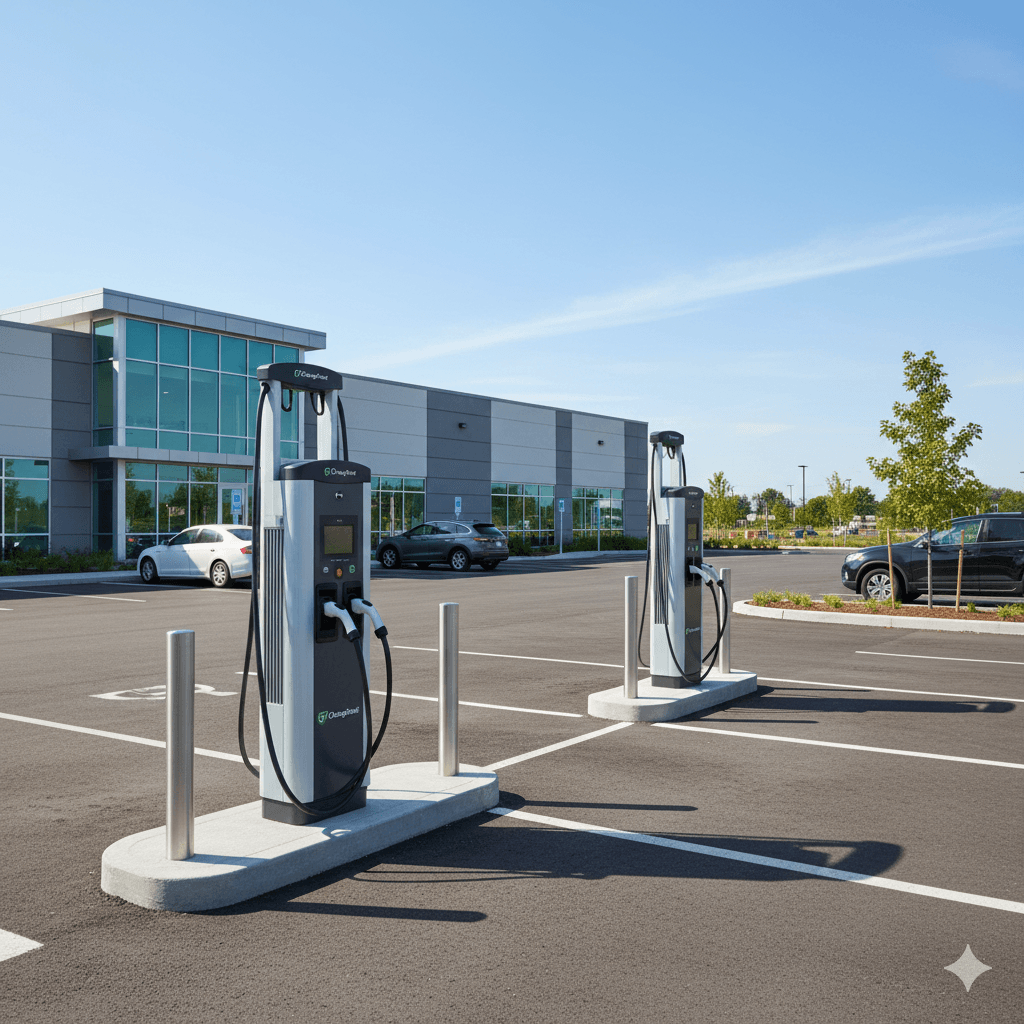
For many businesses, EV charging starts small. A few employees switch to electric cars. Customers begin asking whether they can charge when they visit. Perhaps six 11kW chargers are installed in the car park.
Then EV adoption grows. Six chargers need to become twelve. Fleet vehicles enter the picture. Employees and visitors need different access. Charging may no longer be free. The site has limited electrical capacity. And somebody has to make sure the whole thing actually works.
At that point, you don't have a few EV chargers. You have an EV charging estate.
And that requires a different approach.
Think beyond the charger
The important question isn't simply which charger to install. It is: how should EV charging work for this business over the next five years?
- If six chargers become twenty, can the site's electrical infrastructure support them?
- Can available power be managed intelligently rather than simply upgrading the grid connection?
- Who gets priority when demand is high — fleet, employees or visitors?
- How do people access charging, and who pays?
- Who monitors the chargers, deals with drivers when something goes wrong, and plans the next phase?
These decisions should not be made after the chargers have been installed. They should shape the charging estate from the beginning.
Design → Build → Operate → Grow
That is how we approach commercial EV charging at Pretium Synergy. We don't see the chargepoint as the finished product. We see the charging estate as the product.
Pretium designs the estate around the business and its future demand. We build it. And as a Charge Point Operator (CPO), we operate it — managing the charging environment rather than simply handing over installed hardware. Then, as EV demand changes, we grow it.
One charging estate. One accountable partner.
Growth changes the energy question
Six 11kW chargers are one thing. Twenty, forty or fifty chargers can materially change the energy requirements of a site. But adding grid capacity isn't necessarily the first or only answer.
Load management can help make better use of existing capacity. Charging can be scheduled. And as demand grows, solar generation and battery storage may become part of the commercial equation.
The question gradually becomes bigger than EV charging: how should the site generate, store and use energy most effectively? That is where our role as an energy optimiser starts to complement our role as a charging infrastructure partner.
Not every site needs solar. Not every site needs batteries. But every growing charging estate should understand its relationship with the wider energy system.
Build for where you're going
Workplace, fleet and destination charging have different requirements. But they share one principle: don't install for today's number of EVs without thinking about tomorrow's charging estate.
Pretium has been approaching commercial EV infrastructure this way for years — designing, building and operating charging infrastructure rather than treating the chargepoint as an isolated installation. Today, that distinction matters more than ever.
Design it. Build it. Operate it. Grow it.
One partner responsible for your EV charging estate — from the first chargepoint onwards.